Evict the Rats! House Our Families!

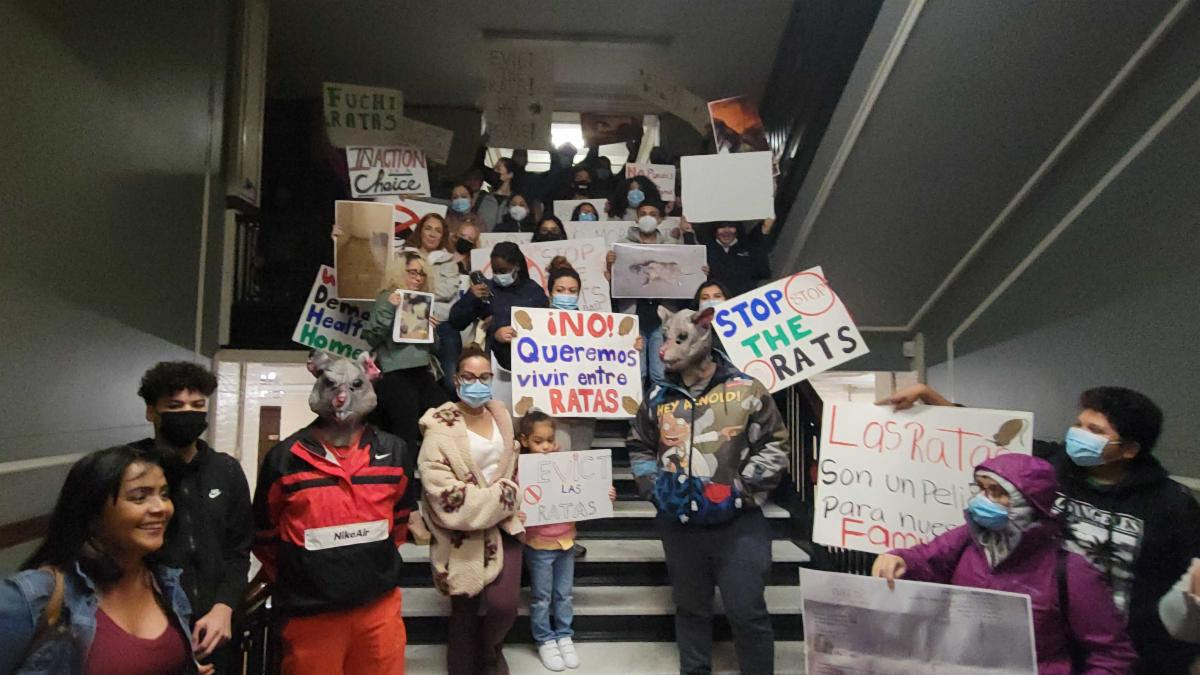
a group of people holding signs saying "stop the rats!"

La Colaborativa youth and families gathered to shine a light on Chelsea’s rat problem this week at city hall, calling on local officials to do more to improve housing conditions for our families. Housing resources should focus on addressing rat infestations and other quality of life issues, instead of evicting families.

The rat infestations have been worsening in Chelsea, with rodents crowding into homes and filling the streets and parks. Our members are reporting “cat sized” rats crawling through their homes, eating their food, and leaving excrement all around their families. Rats spread disease, contribute to the high rates of asthma and allergies in our community, and lower our quality of life.

“We want to live in better conditions. We want the City Council of Chelsea to do something about this and we need the Board of Health to take over this situation and do something…We deserve a clean city free from rats. Our families deserve better,” said Youth Leaders Joel Yanez and Tiary Moran in their testimony to the City Council.

Many of our families enduring rat infestation have received no response from their landlords or city officials. At the same time, they’re facing eviction notices and harassment for late rent payments. La Colaborativa is calling on city officials to increase resources for pest control and extend the eviction moratorium.

To help empower tenants, La Colaborativa also joined with the Mass Law Reform Institute to develop a new online tool, Up to Code, to help tenants document living conditions in their homes and take action to get repairs completed. The website helps tenants understand their rights, allows them to track problems, upload documentation, and choose a next step, such as downloading pre-filled documents or requesting an inspection.

Document bad housing conditions from MA Law Reform Institute on Vimeo.
Land Acknowledgment

At La Colaborativa, we believe that building a more just, equitable, and healthy future begins with recognizing the histories of the land and the communities that came before us, while confronting the systemic inequities that continue to shape our society today.

We acknowledge that La Colaborativa is located in Winnisimmet, now known as Chelsea, Massachusetts, on the ancestral and unceded homeland of the Massachusett People, whose deep connections to this land, culture, and community endure today.

We honor the Indigenous peoples who have stewarded this land for generations and recognize the lasting consequences of colonization, forced displacement, dispossession, and systemic injustice. These histories are not simply part of the past. Their legacies continue to influence access to land, housing, healthcare, education, economic opportunity, and the resources that allow individuals, families, and communities to thrive.

At La Colaborativa, we understand that health equity cannot be achieved without addressing the social determinants of health, the conditions in which people are born, grow, live, work, and age.

Structural racism, poverty, housing instability, food insecurity, and barriers to education, employment, and healthcare disproportionately affect immigrant, Indigenous, and historically marginalized communities, perpetuating cycles of inequality across generations.

This understanding is at the heart of La Colaborativa's holistic, community-driven model. Our work recognizes that the challenges facing our communities are deeply interconnected and cannot be addressed in isolation. By integrating housing stability, food access, healthcare, workforce development, education, economic mobility, and community advocacy, we work to address the root causes of inequity, strengthen community resilience, and create pathways toward lasting social and economic opportunity.

Rooted in our mission of Levantando al Pueblo, we believe that meaningful change begins by centering the voices, experiences, cultural identities, and leadership of the communities most affected by systemic injustice. Just as we honor the resilience and enduring presence of Indigenous peoples, we recognize the strength of immigrant families and historically marginalized communities who continue to shape our collective future.

For us, a land acknowledgment is more than a statement of respect. It is a reminder of our responsibility to turn recognition into meaningful action, challenge the systems that perpetuate inequality, and advance a model of community well-being grounded in dignity, belonging, self-determination, and justice.

We offer this acknowledgment with respect and gratitude to the Massachusett People, their ancestors, elders, and present-day communities, and with a continued commitment to learning, solidarity, and building a future where every community has the resources, opportunities, and power to thrive.