
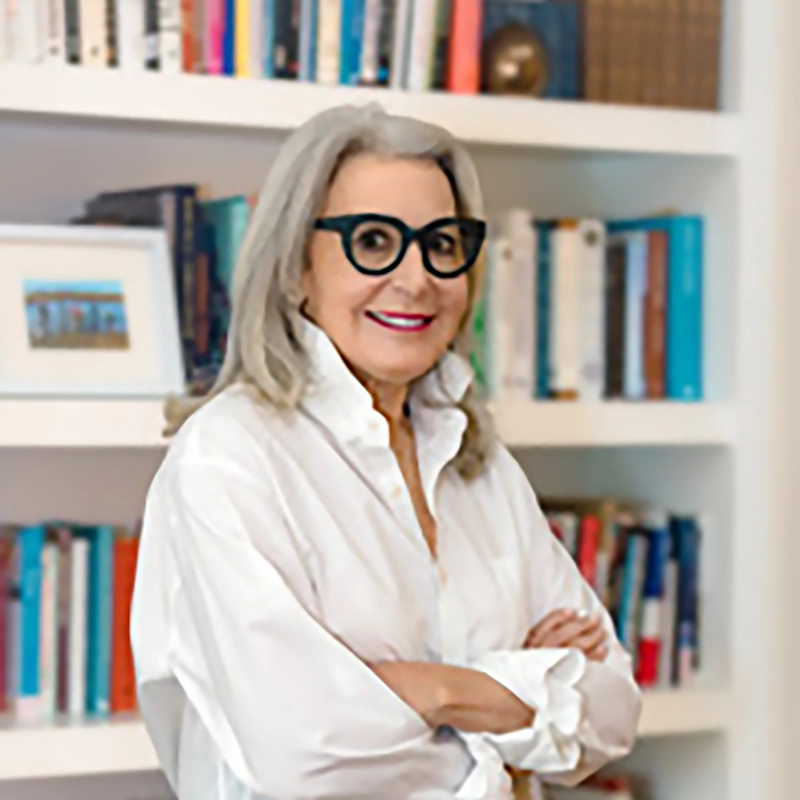
Ellen Rovner

Ellen Rovner

Board Member

Anthropologist,
Brandeis University Women’s Studies Center

Ellen is the founder and director of the Chelsea Gateway Project, an ensemble of community-based initiatives celebrating Chelsea’s rich immigrant history and building on the city’s enormous potential as a showplace for the American immigrant experience. As part of this ongoing project, Ellen initiated and conducts Chelsea Jewish Tours, a series of walking day trips recognizing and reflecting on Chelsea’s extensive Jewish immigrant history and its legacy for a community that has recently become home to Hispanic, African, and Asian immigrants. In addition, for Chelsea Prospers, the city’s neighborhood vitality initiative, Ellen has fostered cross-cultural connections by developing online neighborhood, food, and storytelling excursions. Ellen is the executive producer, writer, and narrator of Chelsea, the Jewish Years, a documentary film featuring oral histories from Chelsea’s twentieth-century Jewish community.

Ellen has taught food anthropology and ethnography courses as a visiting professor in Boston University’s Liberal Arts and Gastronomy master’s program. In addition, as a visiting scholar in Brandeis University’s Women’s Studies Research Center, Ellen researched women’s food voices as vehicles for social action; published online essays and commentaries concerning food, families, class, and ethnicity; developed a dissertation-based research manuscript; and mentored Brandeis University undergraduates through the school’s Student Scholar Program. Ellen has also taught courses in cultural anthropology, food and culture, power and violence, gender studies, and religion as a Brandeis University teaching fellow and university instructor.

Ellen has organized, designed, coordinated, and consulted on social action and community development programs and museum-style exhibits for Temple Emmanuel of Chelsea, the Chelsea Collaborative, Chelsea Prospers, Chelsea Greenroots, Chelsea Community Connections, Healthy Chelsea, Florence, Cohen, and Irwin Chafetz Assisted Living, Brookline Community Mental Health Center, Newton’s Paula Brody and Family Water-Immersion Education Center, Jewish Historical Society of the North Shore, and Temple Israel of Boston.

Ellen has published articles and essays on food, gender, conflict, and culture for the Visions Magazine, Jewish Journal, Huffington Post, Brandeis Initiative on Aging, and Greater Boston Anthropology Consortium. She also wrote a monthly Boston Herald food and lifestyles column. In addition, Ellen has lectured on food, families, class, and culture at numerous North Shore and Greater Boston Jewish institutions and professional anthropological societies in Boston, Chicago, San Francisco, and the U.K.

Land Acknowledgment

At La Colaborativa, we believe that building a more just, equitable, and healthy future begins with recognizing the histories of the land and the communities that came before us, while confronting the systemic inequities that continue to shape our society today.

We acknowledge that La Colaborativa is located in Winnisimmet, now known as Chelsea, Massachusetts, on the ancestral and unceded homeland of the Massachusett People, whose deep connections to this land, culture, and community endure today.

We honor the Indigenous peoples who have stewarded this land for generations and recognize the lasting consequences of colonization, forced displacement, dispossession, and systemic injustice. These histories are not simply part of the past. Their legacies continue to influence access to land, housing, healthcare, education, economic opportunity, and the resources that allow individuals, families, and communities to thrive.

At La Colaborativa, we understand that health equity cannot be achieved without addressing the social determinants of health, the conditions in which people are born, grow, live, work, and age.

Structural racism, poverty, housing instability, food insecurity, and barriers to education, employment, and healthcare disproportionately affect immigrant, Indigenous, and historically marginalized communities, perpetuating cycles of inequality across generations.

This understanding is at the heart of La Colaborativa's holistic, community-driven model. Our work recognizes that the challenges facing our communities are deeply interconnected and cannot be addressed in isolation. By integrating housing stability, food access, healthcare, workforce development, education, economic mobility, and community advocacy, we work to address the root causes of inequity, strengthen community resilience, and create pathways toward lasting social and economic opportunity.

Rooted in our mission of Levantando al Pueblo, we believe that meaningful change begins by centering the voices, experiences, cultural identities, and leadership of the communities most affected by systemic injustice. Just as we honor the resilience and enduring presence of Indigenous peoples, we recognize the strength of immigrant families and historically marginalized communities who continue to shape our collective future.

For us, a land acknowledgment is more than a statement of respect. It is a reminder of our responsibility to turn recognition into meaningful action, challenge the systems that perpetuate inequality, and advance a model of community well-being grounded in dignity, belonging, self-determination, and justice.

We offer this acknowledgment with respect and gratitude to the Massachusett People, their ancestors, elders, and present-day communities, and with a continued commitment to learning, solidarity, and building a future where every community has the resources, opportunities, and power to thrive.