
This is Chelsea’s Emergency Room

Covid- food pantry

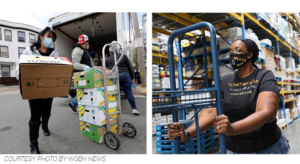
Tanairi Garcia looked around the lobby of the food pantry which had closed for the evening with a sigh: “This is Chelsea’s emergency room. We call it a food pantry, but this is an emergency room.”

Tanairi is La Colaborativa’s Food Pantry Director and spends her days doing whatever it takes to get food out to our families. She and her staff know many food recipients by name and spend time walking the food lines to check in with people and see how they’re doing. More often than not, the supports needed (and provided) go far beyond food.

There are newly arrived immigrants to Chelsea whose first stop is La Colaborativa after enduring unspeakable traumas and family separations during their journeys north. There are unemployed workers, evicted tenants, and worried parents. Victims of domestic violence, consumer fraud, and other crimes who are afraid to reach out to police due to immigration status or fear of retaliation. People searching for information from a trusted source – about COVID, vaccinations, accessing healthcare, and asserting their rights. It’s the culmination of a community of people who have faced a lifetime of structural inequities, lack of opportunity, and cycles of poverty that keep them in constant survival mode.

Tanairi often finds herself as the first point of contact for people in crisis, stepping in to help families secure housing, schooling, counseling and a long list of other services. What started as a food pantry has quickly evolved into a full service survival center, teeming with staff, case managers and community partners at the ready to meet the needs of our community.

Over the last two years, our food pantry has adapted to the ever changing needs of our community in crisis by listening to the voices in our food line. While we opened our doors as a food pantry in response to the overwhelming food insecurity brought to light by the COVID-19 pandemic, it has become so much more. 5,000 or more families each week access free food, clothing, and essentials at 25 Sixth Street, but many more seek out La Colaborativa’s full scope of wrap-around services while in crisis.

That’s why, in 2022, La Colaborativa will open the Chelsea Survival Center, a central hub where all our services, from housing help and RAFT applications to job placement and more, can be found. This space, owned by La Colaborativa and our community members, will be a place that everyone in Chelsea, and beyond, feel that they’re safe and at home.

Land Acknowledgment

At La Colaborativa, we believe that building a more just, equitable, and healthy future begins with recognizing the histories of the land and the communities that came before us, while confronting the systemic inequities that continue to shape our society today.

We acknowledge that La Colaborativa is located in Winnisimmet, now known as Chelsea, Massachusetts, on the ancestral and unceded homeland of the Massachusett People, whose deep connections to this land, culture, and community endure today.

We honor the Indigenous peoples who have stewarded this land for generations and recognize the lasting consequences of colonization, forced displacement, dispossession, and systemic injustice. These histories are not simply part of the past. Their legacies continue to influence access to land, housing, healthcare, education, economic opportunity, and the resources that allow individuals, families, and communities to thrive.

At La Colaborativa, we understand that health equity cannot be achieved without addressing the social determinants of health, the conditions in which people are born, grow, live, work, and age.

Structural racism, poverty, housing instability, food insecurity, and barriers to education, employment, and healthcare disproportionately affect immigrant, Indigenous, and historically marginalized communities, perpetuating cycles of inequality across generations.

This understanding is at the heart of La Colaborativa's holistic, community-driven model. Our work recognizes that the challenges facing our communities are deeply interconnected and cannot be addressed in isolation. By integrating housing stability, food access, healthcare, workforce development, education, economic mobility, and community advocacy, we work to address the root causes of inequity, strengthen community resilience, and create pathways toward lasting social and economic opportunity.

Rooted in our mission of Levantando al Pueblo, we believe that meaningful change begins by centering the voices, experiences, cultural identities, and leadership of the communities most affected by systemic injustice. Just as we honor the resilience and enduring presence of Indigenous peoples, we recognize the strength of immigrant families and historically marginalized communities who continue to shape our collective future.

For us, a land acknowledgment is more than a statement of respect. It is a reminder of our responsibility to turn recognition into meaningful action, challenge the systems that perpetuate inequality, and advance a model of community well-being grounded in dignity, belonging, self-determination, and justice.

We offer this acknowledgment with respect and gratitude to the Massachusett People, their ancestors, elders, and present-day communities, and with a continued commitment to learning, solidarity, and building a future where every community has the resources, opportunities, and power to thrive.